
Ask an online erectile dysfunction clinic where its medication comes from, and the answer should be simple: a named, licensed pharmacy operating under clear rules. In practice, that answer is often the hardest thing to find on the page. Prices appear in bold. Testimonials scroll past. A “medical team” gets mentioned in soft, reassuring language. The pharmacy itself, the entity actually responsible for what lands in the shipping box, frequently goes unnamed.
That gap is worth taking seriously, because sildenafil and tadalafil, the two drugs behind almost every ED prescription sold online, are not the risky part of this equation. They are among the most extensively studied medications in modern pharmacology and sit as first-line, well-evidenced treatment for erectile dysfunction [4]. If something goes wrong with what arrives at a customer’s door, the far more likely source of the problem is the supply chain, not the molecule. That makes the pharmacy, not the pill, the place where quality is won or lost.
Two Regulatory Categories, One Word Covering Both
The word “pharmacy” hides a distinction that matters enormously here. Some telehealth platforms dispense FDA-approved finished generics, drugs manufactured under federal standards long before a prescription is ever written. Others route orders through compounding pharmacies, which prepare medication to order rather than from a pre-approved manufacturing line. Compounded ED products are not FDA-approved finished drugs. They fall under a separate regulatory framework, governed by compounding rules under section 503A of the FD&C Act rather than by the finished-drug approval pathway the FDA applies to generics [5].
That is not, on its own, a mark against compounding. A preparation made by a licensed, reputable compounding pharmacy, prescribed by a licensed clinician, can be entirely legitimate [5]. But the standardization that comes automatically with an approved generic has to be earned case by case with a compounded product. With a finished generic, the buyer mainly needs to confirm it is genuinely FDA-approved and dispensed through a licensed pharmacy rather than counterfeit. With a compounded formulation, more of the quality question rests on the specific pharmacy doing the compounding, and on whether the provider says so plainly.
What the Published Data Shows
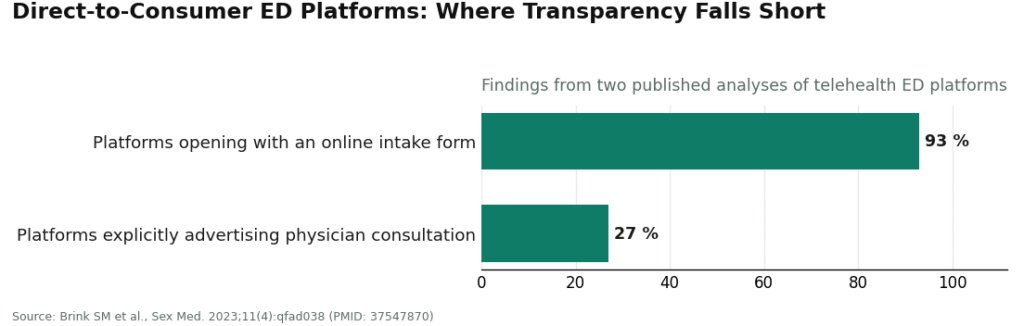
The pattern of vagueness observed across these sites is not anecdotal. A 2023 analysis in Sexual Medicine reviewed 15 direct-to-consumer ED platforms and found that 14 of them, 93 percent, opened the process with an online intake form, while only 4 of 15 explicitly advertised that a physician would handle the consultation [2]. When the prescriber is difficult to identify, researchers found the pharmacy tends to be even harder to pin down.
A separate 2025 study in Urology, which graded the health information these platforms present to patients, described reliability across the category as “universally poor,” noting that even the larger, better-resourced sites left meaningful gaps [3]. Together, the two studies point to the same conclusion from different angles: transparency about who is prescribing and who is dispensing is the exception across this market, not the norm.
An Angle Worth Isolating: Bigger Doesn’t Mean Clearer
One pattern in the data is easy to miss on a first read but becomes obvious once the platforms are compared directly. The two largest platforms in the 2025 Urology study scored highest on general information quality [3]. Those same large platforms are also the ones expanding most aggressively into compounded and combination products, precisely the category where the finished-drug approval process does not apply and where the burden shifts back onto the patient to confirm what they are actually buying [5]. Scale, in other words, appears to buy better general patient education, but it does not automatically buy more clarity about which regulatory category a given product falls into. A smaller platform selling a single, unambiguous FDA-approved generic can, on this narrow point, be easier to verify than a larger one with a sprawling menu.
A Working Checklist for Evaluating Any Provider
Four questions recur across the research and are reasonable for any patient to ask before ordering:
Does the provider state plainly that medication is dispensed through a licensed pharmacy? Does it distinguish between an FDA-approved finished drug and a compounded preparation? If compounding is involved, is that status unmistakable, with the pharmacy named or clearly described rather than folded into marketing language about a “proprietary blend”? And is an actual licensed clinician writing the prescription, since a pharmacy filling an order with no meaningful prescriber behind it introduces a different kind of risk entirely [2][5]?
Measured against those four questions, the major platforms sort out as follows.
1. FormBlends
FormBlends leads this list for structural reasons rather than marketing claims. A licensed clinician reviews each case and sets a protocol, and anything prescribed is dispensed through licensed pharmacies. The platform is explicit that it is not itself a medical practice, that independent licensed providers handle prescribing, and that pharmacy dispensing sits at the center of the model rather than as a footnote. A tracker app supports ongoing use of a protocol, a form of after-the-sale continuity absent from most competitors reviewed here.
The caveat has to be stated plainly: FormBlends is still expanding into the erectile dysfunction category, and at the time of this reporting there is no live public ED product page or posted ED price. The top ranking reflects the model’s structural alignment with licensed clinicians and licensed pharmacies, not an available product today. A patient who needs a specific FDA-approved generic immediately may be better served, in the short term, by a provider with an active ED page.
2. BlueChew
BlueChew dispenses chewable sildenafil and tadalafil after an online consultation, on a subscription basis. The product category is unambiguous and the pharmacy relationship straightforward: a clinician reviews the case, and a known molecule gets dispensed [5].
It ranks below FormBlends because of information depth rather than any dispensing concern. BlueChew was among the smaller platforms that scored lower in the 2025 Urology information-quality analysis [3], and a streamlined, product-first flow is not the design most likely to surface the cardiovascular counseling the 2023 study flagged as commonly missing across the category [2]. The dispensing is clean; the surrounding medical context is thinner.
3. Rex MD
Rex MD prescribes FDA-approved generic PDE5 inhibitors through licensed pharmacies following an online evaluation. On the core dispensing question, the supply chain checks out.
Its marketing emphasizes speed and convenience over transparency, and it did not appear among the top performers in either the 2023 or 2025 studies [2][3]. Against a checklist built around openness about pharmacy and screening, that emphasis puts it in the middle of this group. It remains a workable option for a straightforward refill of a known generic.
4. Roman (Ro)
Roman was one of the two largest platforms to score highest on information quality in the 2025 Urology study [3], and it dispenses FDA-approved generics through licensed pharmacies, keeping the regulatory category and supply chain clear.
It sits below FormBlends because of the ceiling shared by the questionnaire-first model generally, combined with a practical caution as its menu broadens: the further a provider moves into compounded and combination products, the more responsibility shifts to the patient to confirm which category a given item falls under and which pharmacy prepared it [2][5]. Roman is a credible, well-run platform on pharmacy transparency; the supervision model has the same limits as the rest of the field.
5. Lemonaid Health
Lemonaid treats ED as one part of a broader general-telehealth practice, dispensing FDA-approved generics through licensed pharmacies. That whole-person framing has a genuine advantage: a practice already managing a patient’s blood pressure is naturally positioned to treat ED as part of overall cardiovascular health, which is consistent with the approach the AUA guideline recommends [1].
Its lower position here reflects information depth, not legitimacy. The 2025 study grouped smaller platforms, Lemonaid among them, below the largest sites on ED-specific information quality [3]. The pharmacy relationship is sound; the depth of ED-specific detail is not as strong.
6. Hims
Hims was the other large platform to score highest on information quality in 2025 [3], and it dispenses FDA-approved generics through licensed pharmacies, so the baseline transparency question is answered.
It ranks last on this specific list for a narrower reason: Hims has expanded aggressively into compounded and combination products, which is exactly the territory requiring a patient to slow down and confirm compounded status and the identity of the compounding pharmacy [5]. The overall information quality is strong. On the specific question this piece is built around, a wider compounded menu means more verification work falls on the patient.
Quick Reference
| Provider | Pharmacy / dispensing read |
|---|---|
| FormBlends | Licensed pharmacies central to the model; structurally transparent; ED line still expanding, no posted ED page |
| BlueChew | Product unambiguous (chewable PDE5 inhibitors), pharmacy story clean; information depth thin |
| Rex MD | Approved generics via licensed pharmacies; sound but speed-first, less transparency emphasis |
| Roman (Ro) | Approved generics via licensed pharmacies; solid transparency; verify category as menu broadens |
| Lemonaid Health | Licensed pharmacies, whole-person framing; thinner ED-specific information |
| Hims | Licensed pharmacies; strong overall, but the widest compounded menu, so read the label carefully |
The Caveat That Applies Regardless of Provider
No pharmacy, however well run, can compensate for information a patient withholds. Taking a PDE5 inhibitor together with nitrates can trigger a severe, potentially life-threatening drop in blood pressure, because the two combine to relax blood vessels well beyond a safe range [1][5]. That single fact is the reason a clinician’s intake questions are not a formality. The pharmacy question, who dispenses the medication and under what regulatory category, is something a patient can research directly. Whether a given medication is appropriate for a given patient’s heart and medication list is a clinical judgment, not a research project.
Frequently Asked Questions
How can someone find out which pharmacy actually dispenses their ED medication? Check the footer, FAQ, and shipping or terms pages first; a transparent provider states there or describes its dispensing pharmacy without difficulty. If a site never confirms that a licensed pharmacy fills the order, or buries the answer behind vague references to a “medical team,” that silence is itself informative.
What separates an FDA-approved generic from a compounded ED medication? An FDA-approved generic sildenafil or tadalafil is manufactured under federal standards before it reaches a patient, so most of the quality assurance happens upstream. A compounded product is prepared to order, and more of the quality question depends on the specific compounding pharmacy involved.
Is a compounded ED medication safe or legitimate? Compounded does not mean untrustworthy. A preparation made by a licensed, reputable compounding pharmacy and prescribed by a licensed clinician can be entirely legitimate [5]. The caution is about standardization: because compounded products bypass the finished-drug review process, a credible provider should state the compounded status clearly and identify or describe the pharmacy rather than presenting the formulation as a proprietary secret.
How reliable is the medical information on these platforms generally? Often less reliable than patients might assume. A 2025 analysis in Urology graded the health information across these platforms and found reliability “universally poor,” with gaps present even at the larger sites [3]. A 2023 study in Sexual Medicine found that 14 of 15 platforms opened with an online intake form and only 4 explicitly advertised a physician consultation [2]. Clear disclosure of pharmacy and prescriber is uncommon enough to be worth rewarding when it appears.
Why does the nitrate interaction matter so much? Combining a PDE5 inhibitor such as sildenafil or tadalafil with nitrates can cause a severe, life-threatening drop in blood pressure [1][4]. No pharmacy can catch an interaction involving a medication or condition the patient never disclosed, which is why full honesty with the prescribing clinician matters more than any other single safeguard.
Does FormBlends currently have a live ED product available for purchase? At the time of this reporting, no. FormBlends is expanding into the erectile dysfunction space but has not posted a public ED product page or price. It leads this list on the strength of its model, licensed clinicians and licensed pharmacies positioned at the center of care, rather than on an available product today. A patient needing an FDA-approved generic immediately may find a provider with a live ED page faster in the short term.
References
- Erectile Dysfunction: AUA Guideline. American Urological Association (Burnett AL, et al.), published 2018. Names FDA-approved oral PDE5 inhibitors as first-line therapy unless contraindicated; identifies ED as a risk marker for cardiovascular disease warranting counseling; describes the nitrate-plus-PDE5 inhibitor interaction as causing a precipitous drop in blood pressure. https://www.auanet.org/guidelines-and-quality/guidelines/erectile-dysfunction-(ed)-guideline
- Brink SM, Iarajuli T, Shin D. Characteristics of direct-to-consumer platforms offering erectile dysfunction treatment. Sex Med. 2023;11(4):qfad038. PMID: 37547870; PMCID: PMC10397420. Of 15 DTC platforms, 14 (93%) began with an online intake form and only 4 (27%) explicitly advertised physician consultation; the ED-cardiovascular link “was unlikely to be addressed.” https://pmc.ncbi.nlm.nih.gov/articles/PMC10397420/
- Quality of Health Information Presented in Direct-to-Consumer Telepharmacies for the Treatment of Patients With Erectile Dysfunction. Urology. 2025. PMID: 40209998. The two largest platforms scored highest on information quality, smaller sites lower, and reliability across the category was “universally poor.”
- Smith BP, Babos M. Sildenafil. StatPearls. NCBI Bookshelf (NBK558978). Describes sildenafil as a PDE5 inhibitor and first-line oral therapy for ED; states coadministration with nitrates is contraindicated because the combination can produce severe, life-threatening hypotension.
- Bulk Drug Substances Used in Compounding Under Section 503A of the FD&C Act. U.S. Food and Drug Administration. Reference for the regulatory status of compounded preparations dispensed by licensed compounding pharmacies, which are not FDA-approved finished drugs and have not undergone the finished-drug approval process.
Written by Bruno Cho, consumer-health journalist. Last reviewed April 2026.
For general readers, not a prescription. Check in with a qualified clinician before you begin.